Everyone celebrates the new year in their own way, and some ways are quite unique. One community in Dodge County uses toilet paper to ring in the new year.
There was definitely a lot of fun had in Hustisford where the motto, for the day, was B.Y.O.T.P. or "Bring Your Own Toilet Paper.”
It’s the one day a year where you’ll find more toilet paper in the street, than on the roll. This is the 55th annual "Toilet Bowl," where throwing "T.P." is O.K.
“What’s your favorite part about throwing toilet paper?” reporter Kim Shine asked.
“You get to hit people," responded a 12-year-old girl enjoying the celebration.
Everyone has their own reasons for joining in on the fun. For Mary Dornfeld and her family, it’s tradition.
“It’s very cold, you have to half crazy to be out here," Mary said.
"My best friend and I, we used to come here every New Years and we just throw toilet paper and we just have huge smiles on our faces," added her son Malachi.
Tug-O-War and Water Barrel challenges also filled the day, but there’s more. The Toilet Bowl helps fundraise to preserve a historic piece of Hustisford - the Community Hall.
“That hall was about ready to go under and get demolished and a bunch of volunteers got together and put a lot of effort," Hustisford Community Hall Vice President Kirk Kaul said. "We re-did the upstairs with a brand new bar, new lighting, new paint inside and brand new bathrooms upstairs because we have polka dances throughout the year.”
And it’s likely those improvements will continue with the help of the community, and a few rolls of toilet paper.
Image copyrightGETTY IMAGESImage captionResearchers say the fresh water used to flush the world's toilets each day is six times Africa's total consumption
Researchers in the US say they have created an ultra-slippery toilet coating that could help save vast quantities of water around the world.
Scientists at Penn State University say the coating cuts the amount of water required to flush excrement by 90%.
They say it also prevents bacteria from building up in toilet bowls and reduces associated odours.
The spray, which is more slippery than Teflon, would be affected by urine and need reapplying after about 50 flushes.
Researchers hope that the discovery could help reduce water waste. Every day, more than 141 billion litres of water are used to flush toilets.
According to the researchers, who published their findings in the journalNature Sustainability, the fresh water used to flush the world's toilets each day is six times Africa's total water consumption.
"Our team has developed a robust bio-inspired, liquid, sludge- and bacteria-repellent coating that can essentially make a toilet self-cleaning," Tak-Sing Wong, associate professor of mechanical engineering at the university, toldPenn State News.
"Poop sticking to the toilet is not only unpleasant to users, but it also presents serious health concerns," he said. "Our goal is to bring impactful technology to the market so everyone can benefit," he added.
A British company has patented a new toilet design with a sloped seat. Spend too long on it and you'll get leg cramps.
People are spending too much time in the bathroom at work — and it's bad for their health and productivity. At least that's what a British company claims.
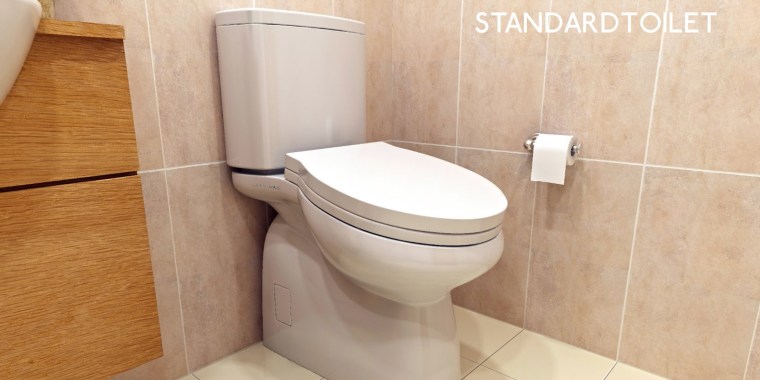
The StandardToilet is similar to most toilets, with a key difference: the toilet's seat and bowl are slanted 11-13 degrees, so that after about five minutes of sitting it causes a strain in the legs.
StandardToilet
Mahabir Gill, the founder of StandardToilet told Wired that the leg pain is not great enough to cause health problems but "you'd soon want to get off the seat quite quickly."
What's the rush?
According to Wired and other published reports, inspiration for the toilet came from Gill's personal annoyance at finding employees asleep on the toilet or growing lines for public toilets and he found that extended bathroom time costs employers money.
According to their website — which has has been taken down — the StandardToilet can increase employee efficiency by reducing the use of social media and reduces lines for bathrooms at shopping malls, public transport, restaurants and sports events.
The company also claims that the slanted design helps with bowel movements by improving posture and reduces the use of pelvic muscles.
Since surfacing on social media, the StandardToilet has received a lot of backlash.
When reached for comment, a StandardToilet spokesperson defended the design.
"Obviously spending less time on the WC is advantageous to the employer, but .. really this (is) the byproduct, with primary health advantages," the spokesperson wrote to TODAY via email. "Once the dust settles and everyone starts thinking rationally, it will become clear that spending too long on the toilet is not healthy."
Dr. Anish Sheth, a gastroenterologist from Princeton, New Jersey, and co-author of "What Your Poo is Telling You", is skeptical of the design and only sees one potential health benefit from the StandardToilet — reducing hemorrhoids.
"There are studies, at least one, that show that people that read on the toilet have bigger problems with hemorrhoids," Sheth told TODAY. "In that study they basically did a base line and told people to stop reading on the toilet and they found that the hemorrhoid problem got better.
The StandardToilet is doing exactly the opposite of the squatty potty which makes your knees more elevated, the optimum angle for going to the bathroom, Sheth points out. Having your knees at a declined slant could make it harder to go, worsen hemorrhoids and make it more difficult for people to leave faster.
Sheth understands the concept, but told TODAY it doesn't seem the right way to go about accomplishing it.
"Why not have a toilet seat that vibrates forcefully every five minutes or something?," he asked. "There would be easier ways to work with existing toilets to achieve the same effect without having to redesign the seat and put strain on legs.
What do you do when nature calls and you're climbing Everest? Digging a hole in the snow is out of the question, although this does happen at some of the camps, explains former climber and engineer, Garry Porter.
How many of us have our best ideas on the toilet?
No really, it can happen. Take Zuraina Zaharin from Malaysia. She's built a business off the back of a loo break. Not just any loo break, of course. This one was near Everest in the early 2000s when she was climbing in the region -- and it was pretty bleak.
"I was facing this problem: the toilet," she explains. "It's easy for men to do their business; they can just do it anywhere. But not for the ladies. We have to wait until we find some nice spot. Even then, I can't do it. I just have to find the toilet."
Things didn't improve upon discovering the facilities, however. "The last toilet at Everest base camp is a pit latrine," Zaharin continues. "The smell, God knows... it's so stinky."


 GETTY IMAGES