A new survey from electronics trade-in website BankMyCell sheds light on America's dirtiest little tech secret. It doesn't matter whether you're a man or woman, iOS or Android user, from the East or West Coast—you probably use your smartphone on the can.
Admit it: You use your smartphone on the toilet. At least three in four Americans do.
That finding comes from a new survey from electronics trade-in website BankMyCell that sheds light on America's dirtiest little tech secret. It doesn't matter whether you're a man or woman, iOS or Android user, from the East or West Coast—you probably use your smartphone on the can, the survey of 2,114 Americans reveals.
Conducted between June 1 and August 31, the survey found that 80 percent of men and 69 percent of woman use their phone on the toilet, albeit some more often than others. Another fun fact: Android smartphone users are 12 percent more likely than iPhone users to text and go.
Teens and young adults are some of the worst offenders. BankMyCell says that 96 percent of Americans under the age of 23 "won't go to the bathroom without their phone."
So what are we all doing on our smartphones as we do our business? Browsing social media, mostly. Texting is the second most common activity, followed by playing music, watching videos, and gaming. Toilet texting is most prevalent in Georgia, California, New York, Mississippi, and Pennsylvania.
When it comes to gaming, hilariously, 25 percent of men admitted to earning a high score on the john. One in 10 men copped to using dating apps on the crapper. And one in three women have sent a selfie snap on the loo.
This unsanitary trend adds up to a lot of germy phones. BankMyCell found that while 90 percent of Americans clean their hands after going to the bathroom, a mere 16.5 percent clean their phones
I think it’s safe to say that this is about to be the grossest thing you’ll read all day. However, it’s probably one of the most important reads as well. Why? Because if you don’t close that toilet lid when you flush, a lot of unfriendly bacteria is going to spray all over your bathroom. And no, this is not a joke.
According to a 2013 review of studies published by the American Journal of Infection Control, it’s clear that flushing your toilet with the lid wide open can pose potential risks. The specific act is called “toilet plume aerosols,” which occurs during flushing. When the toilet contains feces or vomit, the flush can produce potentially infectious aerosols that will live in your bathroom for hours.
Now, keeping your bathroom clean isn’t a new idea, especially since bacteria can easily contaminate toilet seats, lids, surrounding floors or any nearby surfaces. But flushing your toilet probably isn’t in your immediate list of disease-ridden activities. If anything, flushing the toilet feels like a clean activity.
Now, keeping your bathroom clean isn’t a new idea, especially since bacteria can easily contaminate toilet seats, lids, surrounding floors or any nearby surfaces. But flushing your toilet probably isn’t in your immediate list of disease-ridden activities. If anything, flushing the toilet feels like a clean activity.
Here are the specifics: When you flush the toilet, some fraction of the aerosol droplets produced while flushing could contain microbes. Microbes come from infectious diseases from whatever is in that toilet bowl. Vomit and feces can contain high pathogen concentrations such as Shigella, Salmonella, and even norovirus. These pathogens can actually survive on surfaces for weeks or even months.
“Research suggests that this toilet plume could play an important role in the transmission of infectious diseases for which the pathogen is shed in feces or vomit," the study says. "The possible role of toilet plume in airborne transmission of norovirus, SARS and pandemic influenza is of particular interest.”
So for future reference, you may want to start closing the lid when you flush. Especially if that toilet is anywhere close to your toothbrush.
Imagine a product that 30% to 40% of the market chose, every time. That product would be phenomenally successful–nearly twice as successful as the iPhone by marketshare.
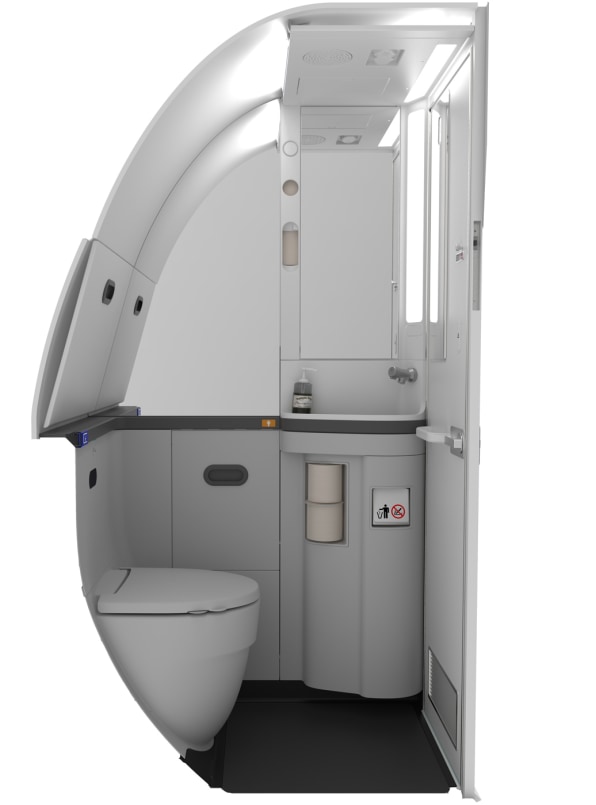
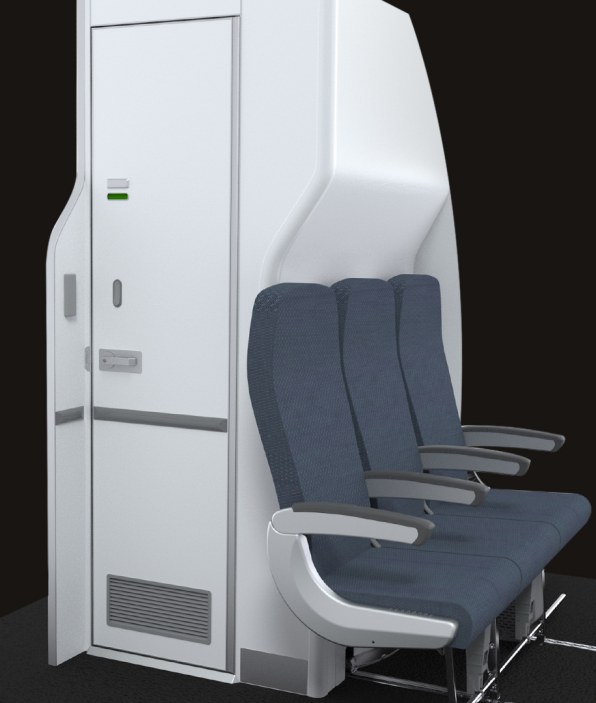
That product exists, but it’s probably not what you’d expect. It’s a new, tinier, economy class airline bathroom called the 737 Advanced Lavatory, which you’ll find on up to 40% of new orders for the popular planes. Designed by the aviation and information technologies company Rockwell Collins for 737s, it buys airlines an additional seven inches of space in the cabin–a football field, in airline terms–sheerly through innovative design.
Yet that seven inches comes from the most precarious seat on the plane. So how are airlines that buy Rockwell’s toilets putting those newfound inches to use–are they using it to make their seats more comfortable, or using it to squeeze even more passengers onto the same planes? “The airlines have become dynamic with new business models,” says Trevor Skelly, VP and general manager at Rockwell Collins. “They can use that space however they wish.”
In other words, it’s controversial, rankling the public while delighting airlines. When the lavatory design was released to the public earlier this year, it was touted as a totem to aviation greed, a symbol of the last human right–defecating in peace–being robbed from the traveling public. And yet, the bathroom has been a hit with big business for a reason. In a world where fuel can be the most dynamic expense for airlines, the most efficient way to run an airline is dependent on cramming the most people in per mile.
DESIGNING THE HOT SEAT
Rockwell Collins designs many models of seat and bathroom for commercial airplanes. Given the increasing importance of space in the air, the firm’s work has largely focused on whittling away hardware components wherever possible, making planes lighter and increasing passenger counts. As Alex Pozzi, vice president for research and development in interior systems for Rockwell Collins, put it to the New York Times last year, “the less size that the seat structure itself takes up, the more space that’s left over for the passenger.”
[Image: courtesy Rockwell Collins]As of late, the possibilities of cabin interior design have accelerated, though, thanks to maturing design tools. “For decades, the size of the bathrooms on an airplane was pretty much laid out in specs that were decades old,” says Skelly. “Typically, what you’d see is a bathroom, a monument with straight walls, and in front of those walls you have seats.”
This was two-dimensional thinking from a time when airplanes were laid out in two-dimensional floor plans. But with modern technologies–like 3D architectural renderings and VR simulations–designers can think about the ergonomics of flight in a whole other dimension.
“In our case, we didn’t reduce the footprint of the lavatory,” says Skelly. “Our innovation was to put a curved wall on the forward face of a lavatory, which in some installations, allows the seats in front [of the lavatory] to have full recline.” In other words, the 737 Advanced Lavatory is shaped like the negative space of a Lay-Z-Boy recliner so people seated in the plane can lean their backs into the bathroom’s air space.
Some of this seven-inch gap was found in the walls, rather than bathroom cabin itself; the designers discovered there was actually some dead space behind and above the mirror. And formerly, a flat wall was built out on both sides of the sink just to make it all one straight line–a five- to six-inch gap across much of the bathroom, which designers largely opened up. The person in the bathroom makes a compromise, but the cabin nets more space as a result. “We did encroach a little in the space inside the lavatory,” Skelly concedes, “but not to the extent we put a curve in the wall [for seats].”
[Image: courtesy Rockwell Collins]
TESTING WITH YOUR PANTS ON
Working alongside the air travel design firm Teague, Rockwell’s designers tested the ergonomics through several mockups built with flexible dimensions. Teague hosted focus groups in various shapes and sizes, from women in the 5th percentile of height and weight to men in the 95th percentile.
“We have a database of these users,” says Skelly. “We call them in. And we get them to go in, close the door, do different things.” The observers will often film video, too–which sounds weird, until you realize the testing is fully clothed. No one actually uses the toilet.
Eventually, Teague and Rockwell Collins figured out the most optimal ergonomic trade-offs. Yes, the new bathroom is smaller, but Skelly points out that its toilet space is larger, because designers cut into that sink wall, which would have butted against the left or right side of the toilet, depending on orientation. “In the seated position, for the 95th percentile guy, he has more knee room than in a traditional lavatory,” Skelly says.
In any case, while having a smaller airline bathroom sounds horrible all around, and most of us dread using a toilet in the sky in the first place, Skelly believes a little bit of misery is actually worth the larger trade-off.
“The person in that aftward [toilet abutting] seat who was sitting for five hours with no recline, will spend five minutes, hopefully, in the lavatory for the whole flight,” he says. Instead, that row of people next to the bathroom can recline. Or perhaps the seven inches are redistributed across three or four rows of seats, giving them all a bit more legroom.
“In some ways it democratizes the economy class of the airplane,” says Skelly.
IT’S YOUR BOTTOM VS. THEIR BOTTOM LINE
In some ways. But in truth, that seven inches is at the disposal of how the airlines themselves would like to use it, and airlines are notorious for maximizing profitabove comfort. The space also opens the door for padding upsell options, like so-called premium economy seating. And in about 50% of cases, the geometry of the plane and seating can actually turn that seven inches into a whole additional row of seating.
“It’s really aligning with the business models–and, at the end of the day, why passengers fly low-cost airlines–it’s how they choose to spend their money. And these kinds of innovations are helping reduce the cost of travel in many cases,” says Skelly. When I openly question that mentality, positing that few of us truly choose to fly economy, but rather, we are forced to by the realities of our finances, he stands his ground.
“Well, you know, I don’t think so. I would disagree with that. I have friends with a lot of money and they choose to fly economy class. I’m flying economy class today to Europe. That’s my choice,” he says. “What I would say is, what we do is create, in conjunction with the airline, a lot of choice to what’s available out there . . . if users think lavatories are a problem on the airline, they can go to the front. Not every lavatory on the airplane has to be like this.”
It turns out all of the traditional headaches associated with airport security -- body scanners, cranky TSA agents, never ending lines -- might be the least of your concerns when trying to catch a flight. Aside from your averagehousehold sponge, which is a bastion of filth in its own right, airport security trays are some of the most bacteria-ridden objects you'll casually encounter.
According to a newstudypublished in the journalBMC Infectious Diseases, the trays where you stow your wallet, cell phone, shoes, sun glasses, and keys are teeming with more bacteria than your average airport toilet. The study, conducted by researchers from the University of Nottingham and the Finnish National Institute for Health and Welfare, involved swabbing a variety of surfaces at Finland's Helsinki-Vantaa airport during the busy season in December of 2016.
The dirtiest surfaces belonged to security trays, outpacing toilets in traces of rhinovirus -- the bacteria that causes the common cold -- and the influenza A virus. In total, traces of virus-causing bacteria were found on 10% of all surfaces, with security bins the most prevalent.
"Of the surfaces tested," the researchers note, "plastic security screening trays appeared to pose the highest potential risk, and handling these is almost inevitable for all embarking passengers."
In fact, out of all the surfaces tested, toilets were found to be surprisingly clean, without a trace of respiratory virus detected.
The results aren't altogether surprising: Helsinki-Vantaa airport is large facility with an annual passenger count of 18,892,386. Still, it's only a fraction of the size of the biggest airports in the world, some of which service four times as many passengers a year. The number of travelers easily lends itself to spreading germs, especially when you consider how filthy youraverage cell phone might be.
The possibility of contracting a cough or something worse lessens when you board a plane, but only slightly. Airplane cabins are usually a pretty fertile breeding ground for germs. There's also the possibility of aerotoxic syndrome -- which happens when engine exhaust from a plane seeps into the cabin's air supply -- although that's far less likely than contracting a cough or sneeze.
With all of this in mind, it remains clear that the key for maintaining health in all of life's ventures is washing your hands after you do anything, anywhere.
When you flush with the lid up, your toilet shoots out tiny water particles mixed with your waste.
Known as toilet plume, these particles could contain harmful bacteria.
Toilet plume has been shown to land on nearby surfaces, and the bacteria can live for months.
When you're done doing your business, do you close the lid of the toilet before you flush? No pressure, but the answer could determine whether or not there's poop bacteria chilling around your bathroom: on your soap; on your towels; on yourtoothbrush.
When you flush, the water in the toilet bowl mixes with waste — be it urine, poop, or vomit — and tiny particles of this mixture are emitted into the air. These droplets are known astoilet plume.
If you don't close the lid on the toilet when you flush, this plume could settle onto nearby objects in your bathroom, according to a2013 review of studiesthat recently resurfaced so we could cringe all over again.
Toilet plume isn't just gross: It's bad for your health. The droplets could contain traces of harmful bacteria likeShigella,E coli,C difficile— all of which are found in the poop and vomit of infected people and can survive for months, according to the paper. The study authors reasoned that toilet plume may help spread infectious diseases, though the subject needed more research.
In 2016,Business Insider'sformer tech siteinterviewed Philip Tierno, a microbiologist at New York University, on the dangers of toilet plume. He said the plume can reach as high as 15 feet in the air — and aside from landing all over your bathroom, it can also land onyou.
"If you have [unbroken] skin, you're likely to be okay," he said. But, uh, he also noted that certain bacteria, like Salmonella and Shigella, are transmitted when poop particles get in your mouth.
Thankfully, the solution to all this nastiness is simple: Close the lid of the toilet before you flush away your waste. If you're in a public bathroom where the toilet has no lid, heed Tierno's advice and "exit at the time of the flush."
No matter what, Tierno said it's a good idea to "make sure your cups and toothbrushes are tucked away." Hey, even if you're diligent about closing the lid, there's no guarantee your three other careless roommates are doing the same.
What are you going to do with this contact lens? (Photo Illustration by Thomas Trutschel/Photothek via Getty Images)
Don't tell me you didn't see this coming. All those contact lens, those little plastic discs, that you flush down the toilet or the sink must go somewhere. Where? Not to the magic contact lens fairy, who cleans up all your messes.
The answer is the environment and then maybe ultimately back into your and everybody's mouthes. Today atthe 256th National Meeting and Exposition of the American Chemical Society (ACS) in Boston, Charles Rolsky, a PhD student, presented work from an Arizona State University team to help people see what is occurring. Rolsky along with Varun Kelkar, and Rolf Halden from ASU conducted a survey of contact lens wearers in the United States.As Rolsky described in a press release: “We found that 15 to 20 percent of contact-lens wearers are flushing the lenses down the sink or toilet.This is a pretty large number, considering roughly 45 million people in the U.S. alone wear contact lenses, amounting to 1.8–3.36 billion lenses flushed per year, or about 20–23 metric tons of wastewater-borne plastics annually."
And this plastic doesn't just disappear. The team also exposed five polymers commonly used in contact lens to the microrganisms that tend to be present at wastewater treatment plants. They found that these microorgamsims break the polymers down into microplastics. These microplastics then can make their way into the food supply, which then can make it into our meals. So if you want to save this journey, maybe you should just eat your contact lens rather than flush them down the toilet and sink.
All of this shows that you should be careful about what you are sending down into the water supply. Poop may be OK in the toilet (but not the sink. Please don't poop in the sink.) However, that doesn't mean that everything else can go where poop goes. Instead, put your old contacts in the trash, where they can potentially be recycled or at least handled like other plastics.
You also probably don't want to store your old contacts under your eyelid, like one woman inadvertently did for 28 years.ABMJ Case Reportscase report presented details on a woman who saw doctors in Dundee, UK, after she developed left eyelid swelling and drooping. The doctors found a rigid gas permeable contact lens that had been lodged under her eyelid since the New Kids on the Block were hitting the charts with their single "Hanging Tough."