IndefinitelyWild is a lifestyle column telling the story of adventure travel in the outdoors, the vehicles and gear that get us there, and the people we meet along the way. Follow us on Facebook,Instagram, and Twitter.
In our extensive experience testing outdoor toilets, we’ve never had a more satisfying poop than the one achieved on this wooden throne in the Cascade Mountains. The view, as you can see, is stunning, but the toilet’s location also shelters it from the wind, basks it in the warm rays of the sun, and offers near complete privacy, thanks to its perch well off the main hiking trail. The combination, we feel, makes it the single greatest toilet in the country.
Why Visit?
While many equally-scenic wild pooping opportunities exist for those prepared to dig a small hole, pack their poo into a baggie, or smear it across rocks, nowhere else offers the comfort of a wooden seat or the ability to carry only toilet paper and reading material with you. While most wild pooping is conducted in a rushed fashion, this toilet offers the pooper the ability to relax and enjoy the experience. If you so desire, an entire issue of the New Yorker can be finished while perched in front of this view.
I would think that a college that looks like a
toilet would not be the first place that students would choose to attend –
unless they want to flush their money down the drain.
Back in February, the State Council of the Chinese central government released an “urban blueprint” calling for buildings that are “suitable, economic, green and pleasing to the eye,”. They didn’t want “oversized, xenocentric, weird.” Oops.
This building was recently unveiled by an educational facility in Hainan, China. And yes, it looks like a toilet. I say just go with it at this point and act like it was intentional. Put in a urinal cake elevator. Even better: Maybe a handle that makes a flushing sound and moves when a water slide elevator jettisons you from floor to floor. It’s all good. We meant to do that.
source: http://technabob.com/blog/2016/07/08/university-looks-like-a-toilet/ by Conner Flynn http://www.thisoldtoilet.com
A plunge into an eighteenth-century toilet in Philadelphia has left archaeologists bowled over with its insights into Revolutionary War life, according to a new report by National Geographic.
While a lot of people usually think of archaeology as uncovering tombs or exploring temples, in reality, the majority of it is straight-up garbage—because while written sources can lie or be misled, the trash they left behind usually tells a more accurate story.
Which is why certain features—like latrines—can cause a lot of excitement, as people frequently used them to dump their trash before trash collection was an established practice. The pit latrine found behind a small Philadelphia house in the summer of 2014 was no exception; dug in 1776 and filled in in 1786, it provides a rare snapshot of life in the nascent United States.
Found fittingly on the future site of the Museum of the American Revolution, the latrine’s 619 artifacts reflect Philadelphia as it began to boom as a trade and manufacturing hub—like German tankards and fine Chinese porcelain (both broken, of course). Such items were then examined in the light of historical research into the time, including deeds, insurance maps, and Quaker meeting minutes.
Photo courtesy of the Museum of the American Revolution
From this, the researchers have been able to estimate the exact date the pit was dug: July 10, 1776, when a couple named Benjamin and Mary Humphreys bought a house in the area. Of course, being a private home, one would assume their latrine would host the usual household garbage, but as it turns out, the Humphreys’ latrine revealed their secrets through their interesting trash.
Instead of broken kitchenware, the archaeologists pulled up huge numbers of drinking glasses, tankards, punch bowls, serving dishes, smoking pipes, and alcohol bottles.
What was the paraphernalia of a bar doing on a property that never had a tavern license, according to records? It appears that the Humphreys were running what was referred to as a “disorderly house”—something like a speakeasy of ill repute. Mary Humphreys would be arrested for this very reason some eight years later, in July of 1783.
Perhaps even more interesting, Some of the artifacts show a bit more of the political leanings of the time, starting with shards of glass with the word “love” etched on it.
"When we first saw that word we thought, 'Oh, it's just some lovesick guy who's drinking too much and writing a message on the window,'" Rebecca Yamin, the excavation's principal archaeologist, told National Geographic.
But then more of the glass was found, leading to a nearly-full phrase being recovered: "We admire riches and are in love with …"
"And we know the last word is idleness," said Yamin. In fact, this was a somewhat popular quote at the time; it comes from an ancient Roman senator named Cato the Younger, and was repeated during a play that was making its rounds at the time. They play involved Cato defying the tyranny of Julius Caesar—which apparently reverberated well with American colonists who wished for independence from Britain.
"This quote would have been known to people who were thinking politically in 18th-century Philadelphia," said Yamin. "This man was writing a political message, which is so consistent with what we know was going on in the taverns at the time."
Of course, all this and much more was found—and some of it is even making its way into the future Museum of the American Revolution when it opens in April of 2017.
"Often in urban sites we dig this stuff up and it just goes into the basement of some state institution, never to be seen again," said Yamin, "but in this case it's really going to be seen. We're really excited about that."
Travis Springer, an English teacher at a Washington language institute, was outside drinking coffee with a friend the other day when he was asked an unusual question, but one that divides folks nationwide:
Which is better, automatic or manual flush toilets?
Springer criticized automatic-flush toilets on the basis of their “weird timing.” The indictment was stronger for urinals. “The urinals, they don't do much for some reason. What I’m saying: Every time I go to one, there's pee in it," he said. "That’s what I’m trying to say. It doesn’t clear it for the next person.”
Springer's views echo a perennial debate about public bathrooms across the country: to flush or to auto-flush. And they may be occurring with increasing frequency as automatic flush toilets have become more commonplace.
The first patents for automatic flush toilets surfaced in the 1970s and 1980s. Clients were wowed by their hygienic offerings and the fact that toilets would actually flush each time they're used, avoiding that maintenance headache of a mess that's been left in a toilet for hours. Industry-wide, sales for automatic flush fixtures have doubled in the past decade, said Orkun Onur, commercial product manager at Kohler, the large plumbing-fixtures company. Onur credited this to automatic toilets' decreasing price and improved technology, but he did not provide any precise data.
Despite that massive boost in sales, these toilets have often irritated, angered and perplexed those taking care of their bathroom business. Users typically find it irritating when these toilets flush with the opening or closing of a stall door or with a person's slightest movements, sometimes splashing water. On the other end, some automatic flush toilets refuse to flush unless you actually press a manual button.
But these anecdotal complaints overlook an even bigger problem with the technology. It's a tremendous waste of water at a time when water is increasingly limited. California, which entered its fifth year of drought in May, is currently operating on 67 percent of its typical water supply. The U.S. Drought Monitor counts 40 percent of U.S. counties to be "exceptionally dry" or in a drought; in the summer of 2012, 80 percent were. And the Colorado River, which sustains 40 million Americans, is slowly running out of water.
Scientists are not optimistic about water's future, either. A 2015 study indicates that the Southwest and Midwest is extremely likely to experience a "megadrought" in 2050 that will last as long as three decades. Drinking water, particularly for major cities such as Phoenix and Los Angeles, will be limited.
That concerns water-efficiency experts such as John Koeller. The Orange County, Calif.-based researcher co-authored a 2010 study comparing manual and automatic plumbing fixtures in a Tampa office building over a 23-month period. Automatic flush toilets use 54 percent more water than their manual cousins. The tendency of automatics to flush when you sit or squat can add up to a lot of wasted water. Manual toilets allow the option of water-saving dual-flush technology.
“Nothing can beat a manual flush in terms of water efficiency,” Koeller said. “One visit, one flush. That's my mantra.”
Automatic flush toilets use 54% more water than manual ones
A 2010 study of a Tampa office building found that automatic-flush fixtures used 436 more gallons of water per day than manual fixtures over a 23-month period.
Those little flushes add up quickly when you look at massive users of automatic toilets. A columnist for the Los Angeles Times wrote last year that the airports in Los Angeles and San Francisco should consider switching to manual toilets as the rest of the region cut back on their own water usage. Respectively, the second- and seventh-largest airports in the country, Los Angeles and San Francisco international airports, could save 80 million gallons of water each year if they nixed the sensor-operated loos. That's equal to the annual water usage for 200,000 families of four.
There’s not much financial incentive to obsess over water conservation, though. Water prices in the United States are much lower than in other countries; it’s as much as 2.7 times as pricey in Germany, for example. We also use twice as much water per capita than themedian of all countries, as tracked by the Organization for Economic Cooperation and Development.
The industry is starting to respond to environmental concerns. Kohler's Onur said the plumbing industry is increasingly concerned with making fixtures that use less water, whether that's toilets that don't flush multiple times per use or use less water in a single flush. "That is one of the biggest hurdles that we are trying to [overcome]," he said.
Anica Landreneau, who directs sustainable design at architecture, engineering and design firm HOK, said the technology already has improved. For instance, toilets are less likely to go off when a sensor detects a light reflected from a chrome bathroom stall.
"I won't say that every manufacturer has it right, but I would say they are evolving and they are sensitive to that feedback when they get it," Landreneau said.
But that's only a change for those buying new toilets. Considering that toilets can last more than 20 years and can cost more than $800 per unit, there is not much toilet-turnover.
Your office toilet unit costs nearly twice as much if it flushes automatically
A commercial toilet unit with a manual flush valve is 48% cheaper than its automatic equivalent. This comparison stacks up two otherwise similar American Standard toilets, both which use 1.1 gallons per flush
Still, the perception that dangerous germs are lingering everywhere in your bathroom has led building managers to go with touchless toilets, sinks, faucets and towel dispensers. At the same time, automatics have also gotten a lot cheaper. For instance, a sensor costs a quarter of what it did in 2006. "The things that we wanted to do are more doable now because the price went down significantly," Onur said.
Now, toilets are even looking toward a future of cloud computing. Building managers will be able to analyze how many flushes and how much water an automatic toilet is using, just as they are able to monitor air-conditioning and electricity usage.
Low-tech or high-tech, bathroom fixtures tend to get a lot of attention when Landreneau talks to clients about their properties. “Sometimes, I end up talking about water fixtures more than anything else," she said.
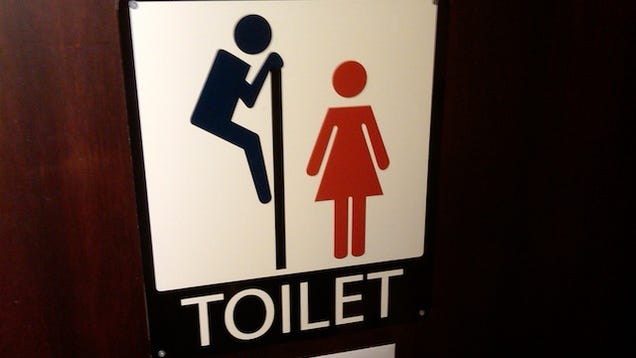
Bored with typical bathroom trope, one DC coffee shop has decided to skirt tradition and go with a mildly rapey bathroom sign that makes customers stop and say, "Wha?"
An eagle-eyed reader sent us this gem, captured at Saxby's Coffee at K Street and Vermont Ave. It appears that the water closet at the establishment is demarcated with a sign that indicates that men just can't get enough of watching ladies erotically use the toilet. What is this, Japan?
Anyway, if you ever find yourself in the District, make your way to Saxby's. Where the coffee is hot, the people are cool, and the stick figures are bathroom peeping toms.
Over seven kilograms of gold, found abandoned in a toilet on a Qatar Airways plane, was seized by Customs investigators at the Goa airport today.
"When the Qatar Airways aircraft (after landing at Goa airport) was searched today, the Air Intelligence Wing found one duty-free plastic bag in the dustbin of the rear left toilet of the aircraft," Commissioner of Customs, Goa division, K Anpazhakan told reporters.
"An inquiry was made with crew members of the aircraft which had arrived from Qatar. They informed that they were not aware of the owner of the bag," he said.
The bag was opened at the international arrival hall of the airport and it was found to be carrying jewellery weighing 7.124 kgs.
"The correct value of jewellery would be known only after an approved valuer is approached. Inquiries were made with the arrival passengers but no one was having any knowledge about it," the Commissioner said.
Mr Anpazhakan said this is the second seizure of gold by Goa Customs in a week.
"Another seizure of two kilograms of unclaimed gold bars was made by officers in the same flight on April 24. The bars were hidden inside the pouch in the life jacket which was attached below a passenger's seat," he said. source: http://www.ndtv.com/goa-news/7-kg-gold-abandoned-in-aircraft-toilet-seized-1400065 http://www.buyetail.com