Wednesday, February 17, 2016

Toilet Replacement Lids and Seats - The waterless toilet that turns your poo into power - This Old Toilet 800-658-4521

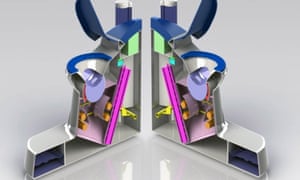
diagram of the nano membrane toilet


 A new toilet design is being trialled in Ghana which uses no water or electricity and can also create energy. Photograph: Cranfield Water Science Institute

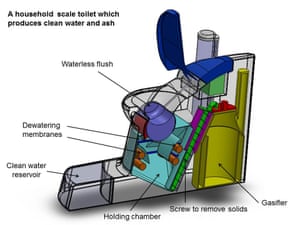
Diagram of nano membrane toilet
Human excrement is rife with pathogens, “odorant volatiles” (the chemicals that make it smell) and parasites, but it has something going for it: it’s about 75% water. What’s more, water is the smallest of all its component molecules.
It’s these qualities of our faecal matter that got researchers at Cranfield WaterScience Institute thinking about how to make a new kind of toilet that can provide safe sanitation to the 2.5 billion people around the world who do not currently have it.


The result was the nano-membrane toilet which removes the water from human waste and leaves solids that can be used as fuel or fertiliser. It works by using a process called “pervaporation” – where mixtures of liquids are separated by vaporisation through a membrane.
The vapour is then recovered and drained into a collection vessel so it can be used for irrigation, household washing or even human consumption. The ingenuity of the nano membrane toilet is that it works without water or electricity, two key services lacking for many of those without access to toilets.
Instead of a flush, the toilet uses a scraper mechanism that sends the waste from the toilet bowl into a collection tank below, where the solids collect at the bottom as sediment and where the liquid waste is filtered. The solid waste is removed into a gasifier which converts it into gas and energy. According to Alison Parker, a water and sanitation expert at Cranfield University, there should be enough surplus power to charge a mobile phone.
The smart toilet is currently being trialled in Ghana. As well as the evident environmental advantages from its self-sustaining treatment system, the toilet promises to provide people with a clean and safe household alternative to the public lavatories that many currently use. This is of particular value to women and girls, who are often vulnerable when going to the toilet outside the house.

Market uptake challenges

Even if the technology proves robust outside the lab, numerous challenges still stand in the way of the toilet’s uptake.
Commercialisation is the most obvious. Parker and her colleagues are weighing up a range of options, but the most likely is a rental model that removes the need for customers to pay up front. Local entrepreneurs could also benefit from providing regular maintenance, the cost of which could be easily bundled into the regular rental package.

Loowatt
, another waterless toilet manufacturer on Parker’s radar, also uses a regular low-cost payment system for its operations in Madagascar. Loowatt, which uses an anaerobic digestion system, charges customers $1.10 (76p) per week to buy refills of the packaging where the waste is stored. “We set the price at an affordable level. If they need more refills they buy more; if they need fewer, they buy fewer,” says Virginia Gardiner, the firm’s chief executive.It’s an approach that has a proven record, says Parker, pointing to the Clean Teamproject in Ghana. The project rents portable toilets to residents in Ghana’s Kumasi district and charges them a fee to collect the waste two or three times a week. To date, nearly 700 toilets have been installed, benefitting 4,500 people.

Driving down costs

Another issue is affordability. The toilet’s designers have yet to fully cost out the nano-membrane toilet as it remains at a prototype stage. However, Parker notes that the hollow-fibre membrane materials are available off the shelf, given their current use in industrial applications such as blood oxygenation and beer nitrogenation, so don’t have to be specially manufactured.
In-country manufacture, an approach envisioned by RTI International is another practical means of keeping production costs low. In addition, RTI’s multi-use toilet block, which converts human waste into burnable fuel and stored energy, uses uniform-sized tanks in an effort to standardise production as much as possible.


“During 2016 we’re working with commercial partners in India to demonstrate [the technology] and hopefully progress towards manufacturing in-country,” says Myles Elledge, a senior director at RTI. “We are targeting [a cost] of about $2,500 per unit, which would serve about 50 users per day and would get us tothe Gates Foundation target of five cents per person per day over a 10-year life.”
Cultural context is all-important, too. You can have the most efficient, most sustainable, most affordable toilet in the world, but social mores and cultural habits may still prevent people using it. According to Parker demand for western-style seat toilets in Africa is high, while squat toilets remain culturally preferable in Asia.
In the case of the nano-membrane toilet, its promoters are looking to pitch it as an “aspirational product”. As Parker says, “We need to make sure we get the marketing right so that people believe it’s a product that they want to invest in.”

source: http://www.theguardian.com/sustainable-business/2016/feb/07/waterless-toilet-turns-your-poo-into-power-nano-membrane-technology
by Oliver Balch

http://www.thisoldtoilet.com

Wednesday, February 10, 2016

Toilet Replacement Lids and Seats - Why smart toilets might actually be worth the upgrade - This Old Toilet 800-658-4521


Whether you're remodeling your bathroom or you're just considering a new toilet, smart toilets are worth a look. Not only are they cool and super techy, they also make your life a little easier. Though there are many types of smart toilets, most have some basic features in common.

Futuristic flushing

First and foremost, they flush without being touched. Each toilet has a sensor that activates the flushing mechanism. Either it senses when a body has moved away from the toilet and activates a flush or you can wave a hand in front of the sensor to get it to activate.
If you're cursed with family members who forget to flush, the first type of sensor is ideal. No matter which one you choose, the perk of having a sensor instead of a handle is that germs won't get transferred from hands to the toilet and then to the next person who flushes.

Overflow protection

As a mom, one of the must-haves on my list when I refurbished my bathroom was a toilet that doesn't overflow. I chose the Delta Brevard with FlushIQ Technology. It stops you from flushing if the toilet is clogged, which keeps water levels in the bowl low.

Water savings and power sources

Smart toilets save water, but they also use electricity, so their environmental benefit is questionable. But you'll see a difference to your water consumption. Smart toilets sense how much water is needed and flush using just the right amount. The smaller flushes can use as little as 0.6 gallons per flush (GPF). A basic toilet that doesn't have smart flush technology uses around 1.6 gallons.
The flipside? All of that swanky technology needs power. There are two power options. Some smart toilets use batteries to power their smart functions, while others need to be connected to your home's wiring system. The battery option is best for those who don't want to call an electrician, though a wired system may suit you if you'd rather not regularly change your toilet's batteries.

More smart toilet features

Smart toilets range in price from a couple hundred dollars to thousands, depending on the features. You can get a basic toilet with just automatic flushing and water sensors, or you can get a fully loaded version with all of the bells and whistles, such as the New Waves Smart Toilet. Here are some options that are available:
  • Massaging bidet wash
  • Air dryer
  • Heated seating
  • Foot warmer
  • Automatic flush
  • Remote control
  • Self-cleaning features
  • Built-in sensors that alert you to possible tank leaks
  • Self-deodorizer
  • Emergency flushing system during power outages
  • Nightlight
  • Slow closing lid
  • Bluetooth and MP3 capabilities so you can listen to tunes while you go
source: http://www.cnet.com/how-to/smart-toilets-make-your-bathroom-high-tech/
by Alina Bradford

http://www.thisoldtoilet.com

Wednesday, February 3, 2016

Toilet Replacement Lids and Seats - Toronto low-flow toilet startup saving money and changing lives one flush at a time - This Old Toilet 800-658-4521


Building Up's new water-saving toilets cut the amount of water from six litres every flush to just three


Marc Soberano does his best thinking on the toilet. The 25-year-old entrepreneur is helping Toronto property owners save water – and money – by retrofitting their bathrooms with energy-efficient toilets.


Marc Soberano wants people to stop flushing their money down the toilet.
The 25-year old Toronto entrepreneur is on an ambitious mission to retrofit Toronto’s restrooms and achieve social and environmental change at the same time.
His startup, Building Up, installs energy-efficient toilets, showers and sinks in low-income housing units across the city. His new toilet models are supplied by Water Metrics, and let users to cut their water consumption in half – from six litres of every flush to three.
“The price of water these days is so high that there’s a huge emphasis from building owners to cut and save,” said Soberano, a graduate of Western University’s School of Business.
“So we go in and change their toilets, and they flush less water and save money just like that.”
Soberano is so confident in his product that he allows clients to have new toilets installed for free and pay out of the savings they reap.
“The numbers are so good that I think every building is going to have these toilets very soon,” he said.
In just two years, Building Up has installed over 1,200 toilets across a dozen buildings in Toronto, saving over 80 million litres of water and about $300,000 in water bills.
Soberano’s success hasn’t gone unnoticed. He recently received a $100,000 business grant from billionaire Michael Bloomberg.
In keeping with his socially conscious business model, Soberano is giving people with employment barriers – whether poverty or a history of criminal activity – a chance to start fresh. They’re given training in math, financial literacy and social skills, and they work installing toilets while the company sets them up with an apprenticeship.
“Most of these people would otherwise get caught up in a situation where they’re in and out of jail,” Soberano said. “But here they get the skills and the job and the money, eventually.”

source: http://www.metronews.ca/news/toronto/2016/01/31/using-toilets-to-achive-social-change.html
by